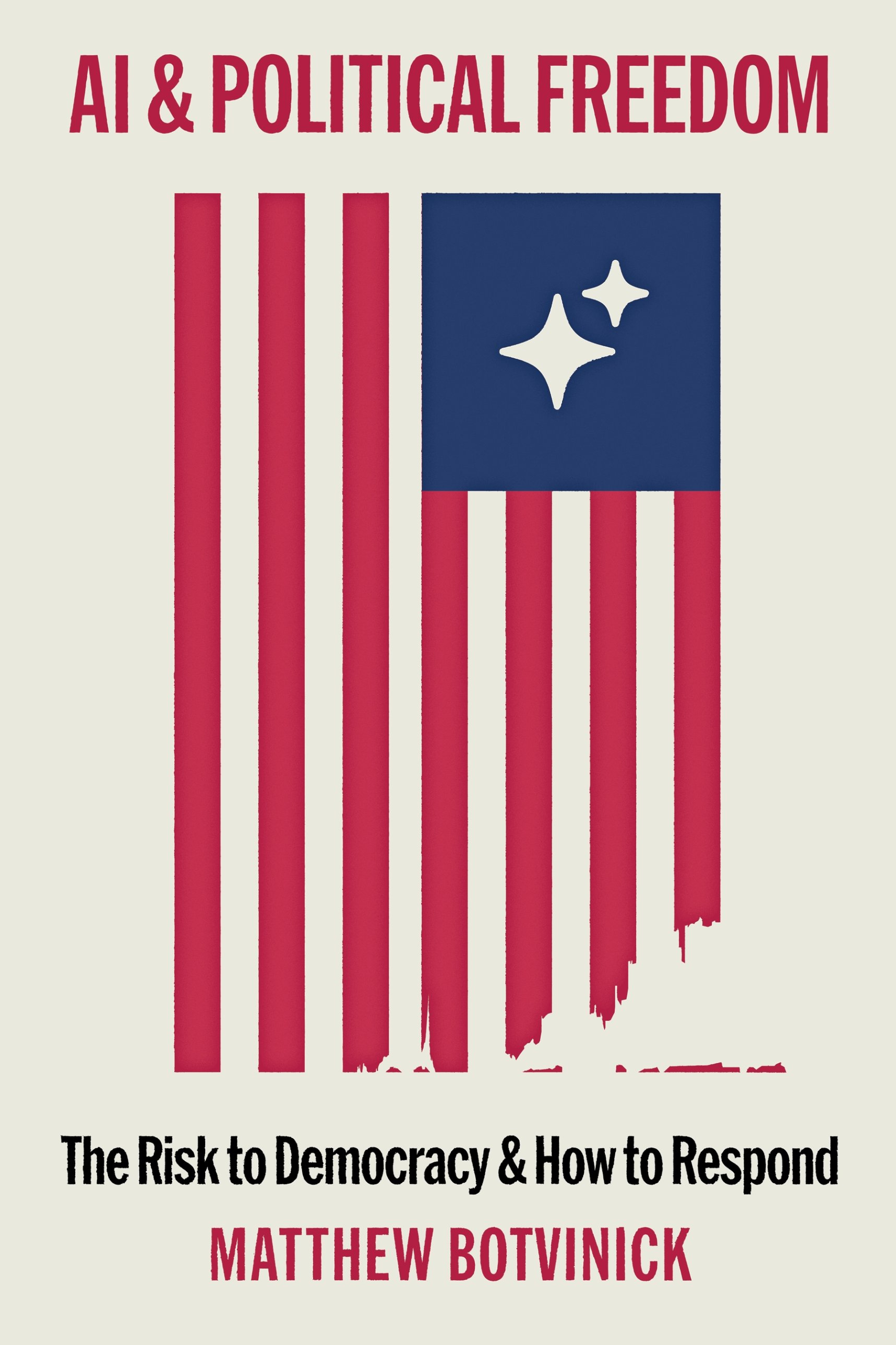
AI and Political Freedom: The Risk to Democracy and How to Respond
Publisher
Princeton University Press
Year
2026
The Information Environment
Counter-Disinformation & Resilience
AI
democracy
authoritarianism
surveillance
deepfakes
disinformation
political freedom
civic participation
AI safety
Cogitavi commentary
Botvinick’s dual position — Yale Law School fellow and Anthropic technical staff — gives this book an unusual vantage point: he understands both what AI systems actually do and what democratic theory requires of them. The argument that AI threatens democracy at its most structurally vulnerable points, rather than simply adding new tools for bad actors, is the right analytical frame. The four mechanisms he identifies — deepfakes and misinformation, unemployment-fuelled authoritarian appeal, emergency-powers abuse, and AI-enabled political surveillance — are distinct in their causal logic, which matters for intervention design.
The prescriptive chapters, advocating for reinforced democratic institutions and richer forms of citizen participation, are less distinctive than the diagnostic ones, but that may reflect the genuine difficulty of the problem rather than analytical weakness. What makes the book a useful addition to this field is precisely what the FIMI literature sometimes lacks: a grounding in democratic theory that allows it to specify which features of democratic governance are threatened by which AI capabilities, rather than treating ‘democracy’ as a homogeneous good to be protected against a homogeneous threat.