PublisherHarcourt, Brace and CompanyYear1922Pages272ISBN9781614277590
The Information Environment
public opinionmediademocracystereotypespolitical communication
Cogitavi commentary
Walter Lippmann's Public Opinion, published in 1922, is the foundational text of modern media theory and political communication. Lippmann argues that what we call public opinion is not a direct reflection of reality but a response to a "pseudo-environment" — a simplified, selective representation of the world constructed by media, institutions, and cognitive shortcuts. His concept of the "stereotype" — not in its contemporary pejorative sense, but as a pre-existing mental category through which we interpret new experience — anticipates by decades what cognitive psychology would later demonstrate about human information processing.
The book's central insight — that democratic governance faces a fundamental problem because citizens cannot directly experience or verify most of the facts relevant to political decisions, and must therefore rely on representations created by others — has only deepened in relevance as information environments have become more complex and more manipulable. Lippmann's analysis of how public opinion is manufactured, how stereotypes resist revision, and why the gap between the world outside and the pictures in our heads creates structural opportunities for manipulation, provides the theoretical foundation on which most subsequent work in this field rests. It should be read alongside Bernays and Ellul as part of the essential canon.
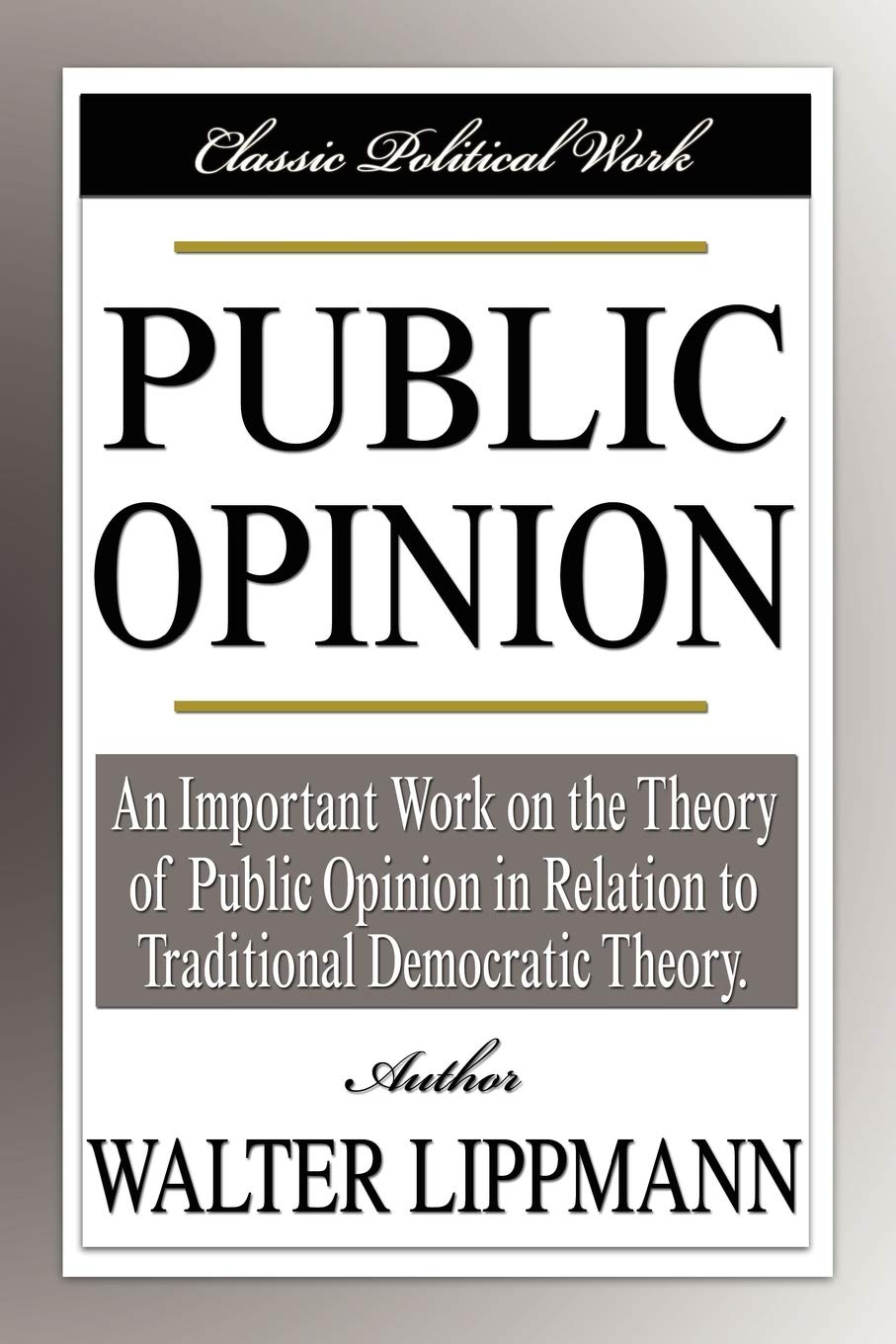
Cogitavi commentary
Walter Lippmann's Public Opinion, published in 1922, is the foundational text of modern media theory and political communication. Lippmann argues that what we call public opinion is not a direct reflection of reality but a response to a "pseudo-environment" — a simplified, selective representation of the world constructed by media, institutions, and cognitive shortcuts. His concept of the "stereotype" — not in its contemporary pejorative sense, but as a pre-existing mental category through which we interpret new experience — anticipates by decades what cognitive psychology would later demonstrate about human information processing.
The book's central insight — that democratic governance faces a fundamental problem because citizens cannot directly experience or verify most of the facts relevant to political decisions, and must therefore rely on representations created by others — has only deepened in relevance as information environments have become more complex and more manipulable. Lippmann's analysis of how public opinion is manufactured, how stereotypes resist revision, and why the gap between the world outside and the pictures in our heads creates structural opportunities for manipulation, provides the theoretical foundation on which most subsequent work in this field rests. It should be read alongside Bernays and Ellul as part of the essential canon.